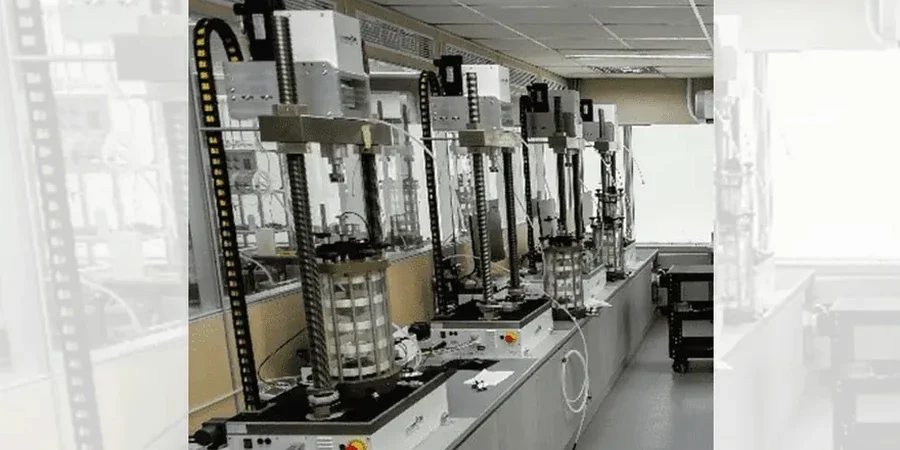
The 2020 National Building Code of Canada (NBCC) requires a rational geotechnical design for all structures founded on compressible soils, and in Medicine Hat, that means dealing with the stiff Cretaceous clay and the overlying glacial till. Our triaxial test program gives project engineers the drained and undrained shear strength parameters they need to size footings, design retaining walls, or check slope stability along the South Saskatchewan River valley. We run consolidated-undrained (CU) and consolidated-drained (CD) stages on Shelby tube samples recovered from depths down to 25 meters, and we back-calculate the effective stress envelope (c’ and φ’) that governs long-term behavior. For bridge abutments on Highway 1 or commercial pads near the Trans-Canada Highway, skipping this stage is a direct risk to the investment. When the stratigraphy suggests cemented layers within the till, we often pair the triaxial campaign with a CPT test to correlate tip resistance with stiffness, giving the structural team a continuous profile between sample depths.
A Medicine Hat clay sample tested at 200 kPa confining stress typically yields an effective friction angle between 24° and 28°—critical data for any slope cut analysis along the river valley.
Our approach and scope
Site-specific factors
A six-storey medical clinic on Dunmore Road was delayed eight weeks because the initial design used generic clay parameters from a regional study instead of site-specific triaxial data. The site investigation showed that the Bearpaw Formation clay contained thin bentonite seams that reduced the residual friction angle to less than 12 degrees. When the structural team recalculated the bearing capacity with our CD test results, the foundation had to be switched from spread footings to a stiffened raft, adding six percent to the concrete budget but eliminating the risk of differential settlement. The lesson is clear: Medicine Hat’s geology is too variable to rely on correlation tables. A single CU test on a high-quality sample costs a fraction of the concrete repair bill that follows a bearing failure, and the data stays valid for the entire design life of the building.
Reference standards
CSA A23.3-14: Design of Concrete Structures (Annex D – Geotechnical Input), ASTM D4767-11: Consolidated Undrained Triaxial Compression Test for Cohesive Soils, NBCC 2020: National Building Code of Canada (Section 4.2 – Foundations), CSA S6-19: Canadian Highway Bridge Design Code (CHBDC)
Complementary services
Consolidated-Undrained (CU) with pore pressure
Measures total and effective shear strength. Ideal for short-term loading analysis on saturated clay layers found beneath the South Flats neighborhood.
Consolidated-Drained (CD) test
Determines the effective friction angle and true cohesion for long-term stability. Required for cut slopes along the Seven Persons Creek and for permanent retaining walls.
Unconsolidated-Undrained (UU) quick test
Provides the undrained shear strength (cᵤ) for fine-grained soils under rapid loading. Used during preliminary screenings of borrow pit material for the City of Medicine Hat landfill expansion.
Typical parameters
Common questions
How many triaxial tests are needed for a typical building pad in Medicine Hat?
For a single commercial building pad up to 2,000 m², we recommend one CU test per distinct soil layer encountered in the borehole, with a minimum of three specimens to define the Mohr-Coulomb envelope. If the stratigraphy includes both glacial till and Bearpaw clay, you should budget for at least six specimens. The exact number depends on the variability observed during the SPT drilling phase.
What is the cost of a triaxial test program?
A triaxial testing program in Medicine Hat typically ranges between CA$2,730 and CA$3,220, which includes specimen preparation, back-pressure saturation, the test itself, and the engineering report. The final price depends on the number of specimens and whether you need CU, CD, or both stages.
How long does it take to get the test results?
A CU test takes 5 to 7 working days from sample setup, while a CD test on Medicine Hat clay can take 14 to 21 days because of the low permeability and the slow strain rate required to dissipate excess pore pressure. We always send a preliminary email with the key parameters as soon as the test is completed, so the design team doesn't wait for the formal report.
Can you test samples of the cemented till found in Medicine Hat?
Yes. The Quaternary till in this region often contains calcium carbonate cementation that makes it behave like a weak rock. We can test these materials in a high-capacity triaxial cell with confining pressures up to 800 kPa, and we use local strain gauges to avoid bedding errors. The report includes the peak and residual strength envelopes.
What quality control do you follow during the test?
All our triaxial tests follow ASTM D4767 and are run under the supervision of an APEGA-registered professional engineer. We calibrate the load cells and pressure transducers every three months against NIST-traceable standards, and we continuously log pore pressure, axial strain, and volume change. The raw data files are archived for seven years, so you can audit any test if a question arises during construction.