With over 63,000 people living along the South Saskatchewan River valley, Medicine Hat deals with some tricky subsurface conditions. The silty clays and loose alluvial sands that make up much of the valley floor don't always cooperate when you're trying to put down a foundation. That's where stone column design becomes a practical alternative to deep piling or massive over-excavation. We've seen local warehouse projects where the cost difference between a full piled solution and a well-designed grid of compacted stone columns was the deciding factor in getting the project off the ground. The approach isn't about selling you a single technique — it's about matching the ground improvement method to the settlement tolerances your structure actually needs. When the native soil under Medicine Hat's commercial corridors shows less than 80 kPa of bearing capacity, a properly executed vibrocompaction program paired with targeted stone columns often brings that number up past 150 kPa without importing thousands of cubic meters of structural fill.
A well-designed stone column grid can double the bearing capacity of Medicine Hat's valley-floor silts while keeping differential settlement under 25 mm — without the cost of a full piled foundation.
Our approach and scope
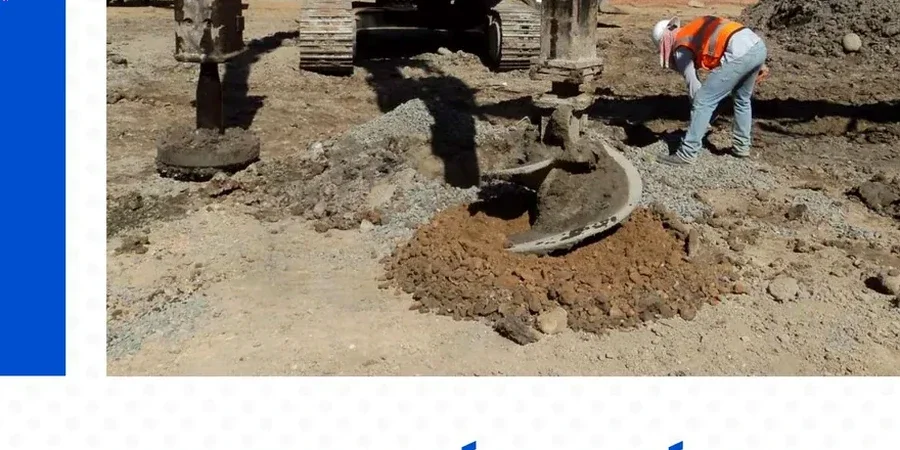
Site-specific factors
The contrast between the north and south sides of the river is stark. Up on the north side near the airport, you're working with relatively stiff glacial deposits — stone columns there might be overkill for a single-story retail box. But head south into the Flats or along the old river channels, and you're dealing with 6 to 10 meters of compressible silty clay that will settle unevenly under load. We've reviewed geotechnical reports from both sides of the valley where the same building footprint showed more than double the predicted differential settlement simply because the alluvial lens thickness changed by 2 meters across the site. That kind of variability is what makes a generic textbook design dangerous. Stone column design in Medicine Hat has to account for the lateral extent of these soft lenses — put columns too shallow or space them too wide, and you'll still get differential movement at column midpoints that shows up as drywall cracking within the first two years. The cost of fixing that after occupancy dwarfs the cost of getting the ground treatment right from the start.
Reference standards
NBCC 2020 — National Building Code of Canada, structural design provisions, CSA A23.3 — Design of concrete structures (column-to-footing load transfer verification), ASTM D1194 / D1194M — Standard test method for bearing capacity of soil for static load (plate load verification), CFEM — Canadian Foundation Engineering Manual, 4th Edition (design methodology reference)
Complementary services
Geotechnical investigation for column design
CPT soundings and select SPT boreholes to characterize compressible layer thickness, undrained shear strength, and groundwater conditions across the buildable area.
Stone column design and layout optimization
Grid spacing, diameter, and depth calculations using Priebe or Balaam & Booker methods, with settlement analysis comparing treated and untreated conditions under your foundation loads.
Post-installation QA/QC and load verification
Plate load tests on production columns, modulus verification, and settlement monitoring protocols to confirm the installed ground improvement meets the design intent.
Typical parameters
Common questions
How much does stone column design and installation cost in Medicine Hat?
For a typical commercial or light industrial project in Medicine Hat, the full scope — investigation, design, installation, and load testing — generally runs between CA$2,200 and CA$7,700 depending on column depth, grid density, and site access conditions. Sites with thicker compressible layers or those requiring deeper columns to reach competent till will land on the higher end. We'll give you a fixed-fee proposal after reviewing your geotechnical data and structural drawings.
When would I choose stone columns over driven piles for a Medicine Hat site?
Stone columns make the most sense when you have 4 to 10 meters of soft but not organic soils, and your structure can tolerate a small amount of total settlement — think slab-on-grade warehouses, low-rise commercial buildings, or embankment support. Piles become the better choice when you need to bypass the compressible layer entirely, or when the soft material contains organics that would clog a stone column. The crossover point is usually around 10 meters of soft soil depth, but we evaluate this case by case with settlement analyses for both options.
What verification testing do you perform after stone column installation?
We typically run plate load tests on at least one production column per critical area of the site, following ASTM D1194 procedures. The test applies staged loading up to 150% of the design working load and measures settlement response at each increment. We also do modulus checks using the pressuremeter or dynamic cone penetration between columns to confirm the surrounding soil has densified as predicted. All results get compiled into a signed QA/QC report you can submit to the municipality.
How long does the stone column design and installation process take?
From the initial CPT investigation to the final load test report, a typical Medicine Hat project runs 3 to 5 weeks. The field investigation and design phase takes about a week to ten days, the vibroflot installation crew is usually on site for 3 to 7 days depending on the grid size, and we schedule load testing within a week after installation to allow pore pressures to dissipate. Winter work is feasible in Medicine Hat but frozen surface crust may require pre-drilling, which adds a day or two to the schedule. More info.