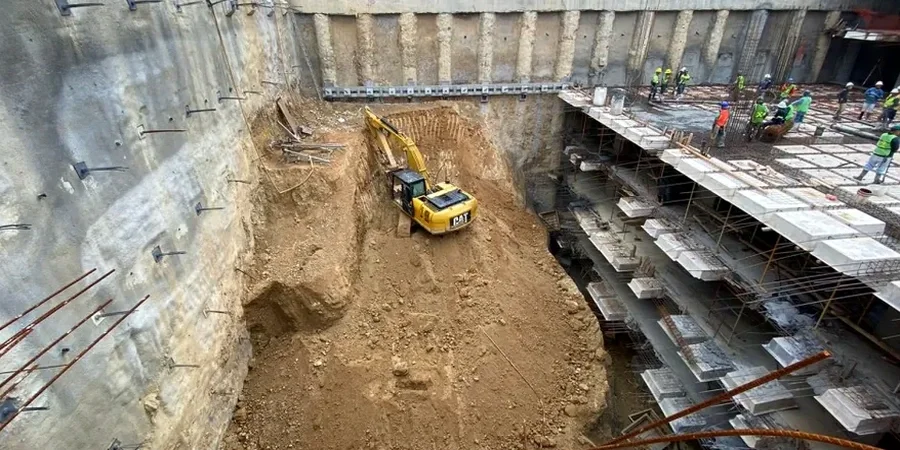
A common mistake in Medicine Hat is treating a 25-foot cut in the river valley the same as one on the flat prairie. The near-surface stratigraphy changes fast around here—glacial till overlying the Bearpaw Formation shale, with sand lenses that love to ravel. When a contractor skips the geotechnical design phase and just wings the shoring, the excavation walls start sloughing within days, sometimes hours if it rains. Getting the bracing geometry and tieback spacing right before the first bucket hits the ground is what separates a smooth dig from a rescue job. For projects near the South Saskatchewan River, where groundwater can be perched in the upper till, we often combine the excavation design with a CPT test to map pore pressure profiles without disturbing the sensitive silt seams.
In Medicine Hat's river valley, the difference between a productive excavation and a 2-week delay is knowing exactly where the shale needs to be sealed within hours of being cut.
Our approach and scope
Site-specific factors
The equipment spreads across the site long before a shovel hits the dirt. A truck-mounted CPT rig pushes a cone through the overburden till to find those sneaky sand lenses, while a track drill recovers 4-inch shale cores sealed in wax to preserve natural moisture. Back in the lab, those cores go straight into a triaxial cell under confining pressures that match the in-situ stress at the final excavation depth. The real danger we are designing against in Medicine Hat is not just wall collapse—it is the slow, expensive deformation that cracks a neighboring building’s foundation or shears a buried fiber-optic line. A poorly designed excavation in the river valley can trigger a progressive block failure along pre-existing joints in the shale, a mechanism documented in several Alberta Transportation reports. Our models run worst-case scenarios with fully softened strength parameters, ensuring the factor of safety is there even after a week of wet weather.
Watch the video
Reference standards
NBCC 2020 (National Building Code of Canada, Division B, Part 4), CSA A23.3-14 (Design of Concrete Structures – Anchorage provisions), ASTM D7181 (Consolidated Drained Triaxial Compression Test for Soils), Alberta Building Code 2023 (ABC 2023), Canadian Foundation Engineering Manual (CFEM 4th Edition)
Complementary services
Shoring and Bracing Design
Complete design of soldier pile, secant pile, sheet pile, and soil nail walls for cuts up to 30 meters. Includes staged excavation analysis, tieback and strut optimization, and a construction sequence that minimizes the time the Bearpaw shale face is left exposed.
Excavation Impact Assessment
Finite element modeling of ground movements adjacent to the excavation, assessing settlement and lateral displacement of nearby footings and utilities. Used for pre-construction condition documentation and for demonstrating compliance with municipal right-of-way protection requirements.
Typical parameters
Common questions
How much does a deep excavation design cost in Medicine Hat?
For most projects in the Medicine Hat area, the geotechnical design of a deep excavation typically ranges from CA$2,550 for a straightforward single-bench cut to CA$12,870 for a fully instrumented, multi-anchored shoring system in difficult ground. The final fee depends on the depth of the cut, the proximity to adjacent structures, the complexity of the groundwater control required, and the number of construction stages that need to be modeled. We offer a fixed-price proposal after reviewing the structural drawings and a preliminary site visit.
What shoring systems work best in the Bearpaw shale found in Medicine Hat?
Soldier pile and lagging walls with grouted tieback anchors tend to perform well in the Bearpaw Formation because the stiff clay shale can stand unsupported for short periods between the piles, allowing lagging installation. Shotcrete facing is often added to control weathering of the exposed shale surface. In areas where sand lenses are present within the till overburden, we typically specify a continuous secant pile wall or soil mix panels to prevent raveling and control groundwater inflow without excessive dewatering.
How long does it take to get a stamped excavation design?
For a typical commercial excavation in Medicine Hat, you can expect an initial design package with shoring cross-sections and construction notes within 10 to 12 business days after we receive the completed geotechnical investigation report. Fast-track projects can be accommodated in as little as 5 business days if the soil parameters are already well-characterized from previous work on the site or adjacent lots. The timeline always includes a review of all subsurface data before we commit to a design.
Do you provide inspection during construction of the excavation?
Yes, part-time or full-time inspection is a standard add-on to our design scope. The inspector verifies that the contractor is following the shoring sequence, measures tieback lock-off loads with a calibrated jack, and checks the as-built geometry against the design. In the Medicine Hat river valley, where a sudden sand seam can change the excavation behavior overnight, having an experienced set of eyes on site can prevent small issues from becoming costly stoppages.