Medicine Hat sits at roughly 670 meters above sea level, carved into the South Saskatchewan River valley where terrace gravels and glacial lake silts stack in unpredictable layers. That elevation and the river’s erosive history create a soil profile that shifts from dense till to soft lacustrine clay within a single city block. When a crew hits those transitions, the assumptions in the structural design need hard numbers. Our soil mechanics study provides that data: grain size distribution, shear strength, consolidation potential, and compaction response. We run the lab work and field sampling in parallel so the report lands on your desk with enough detail to satisfy NBCC 2020 Part 4 and the geotechnical engineer’s review. For deeper bearing layers, we often pair the study with SPT drilling to capture N-values across the full depth of influence.
The biggest cost overruns we see in Medicine Hat come from assuming uniform clay when the borehole hits a sand lens at four meters.
Our approach and scope
Site-specific factors
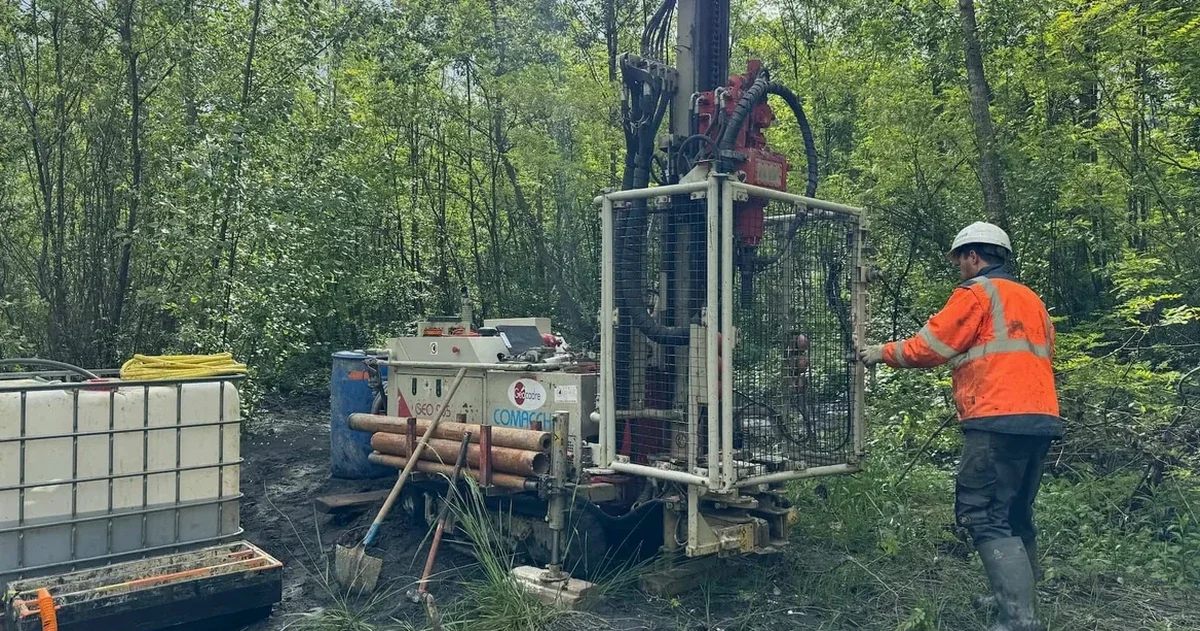
We use a track-mounted drill rig to push Shelby tubes and SPT samplers through the stiff clays and gravels common in the valley. When the auger hits a cobble layer—and it will, somewhere on the north slope—the torque spikes and the sample recovery drops. That’s when the soil mechanics study has to fill gaps with index testing on whatever material we do recover, plus careful logging of refusal depths. Skipping those details leaves the structural engineer guessing whether the refusal was a boulder or bedrock. In Medicine Hat, where till overlies shale at variable depth, that distinction matters for pile design. We log every run, photograph every Shelby tube, and run moisture content on site so the lab results tie back to field conditions without a chain-of-custody headache.
Reference standards
NBCC 2020 Part 4, CSA A23.3:19, ASTM D2487 (USCS classification), ASTM D4318 (Atterberg limits), ASTM D3080 (direct shear)
Complementary services
Foundation Design Soil Package
Index testing, consolidation, and shear strength on undisturbed samples for shallow and deep foundation recommendations in Medicine Hat’s glacial till and lacustrine clay.
Road & Utility Subgrade Analysis
Proctor compaction, CBR, and particle size analysis tied to City of Medicine Hat standard specifications for subdivision and infrastructure work.
Typical parameters
Common questions
How long does a soil mechanics study take from sampling to final report?
Field sampling usually takes one to two days on site. Lab testing runs ten to fifteen business days for a standard foundation package, depending on consolidation and shear test queues. Rush turnaround is available when the excavator is already mobilizing.
What does a soil mechanics study cost for a single-family home in Medicine Hat?
For a typical residential lot, the study ranges from CA$4,580 to CA$6,520 depending on depth, number of boreholes, and whether consolidation or swell testing is required by the geotechnical engineer.
Do you handle the drilling and sampling, or just the lab work?
We manage the full chain: track-mounted drilling, Shelby tube and SPT sampling, sample transport in cooled containers, and all lab testing under ASTM methods. The report includes field logs, lab data sheets, and summary tables ready for the designer’s review.