The subsurface conditions in Medicine Hat shift dramatically between the South Flats and the higher benches of Crescent Heights. Near the South Saskatchewan River, alluvial sands and silts dominate, while the upper terraces hide dense glacial till and weathered shale bedrock. Contractors working on both sides of the valley learn quickly that a single foundation assumption rarely holds across the city. The Standard Penetration Test cuts through this variability, delivering N-value data at depth intervals that correlate directly with bearing capacity and liquefaction susceptibility. In Medicine Hat's river valley, where groundwater fluctuates with seasonal irrigation and snowmelt, combining SPT logging with a test pit investigation helps verify shallow fill extents before drilling begins. The split-spoon sampler recovers disturbed samples that the lab uses for classification, while the blow count provides a repeatable strength index recognized by the National Building Code of Canada.
N-value profiles from Medicine Hat's river valley deposits require energy-corrected N60 for reliable liquefaction assessment under NBCC seismic provisions.
Our approach and scope
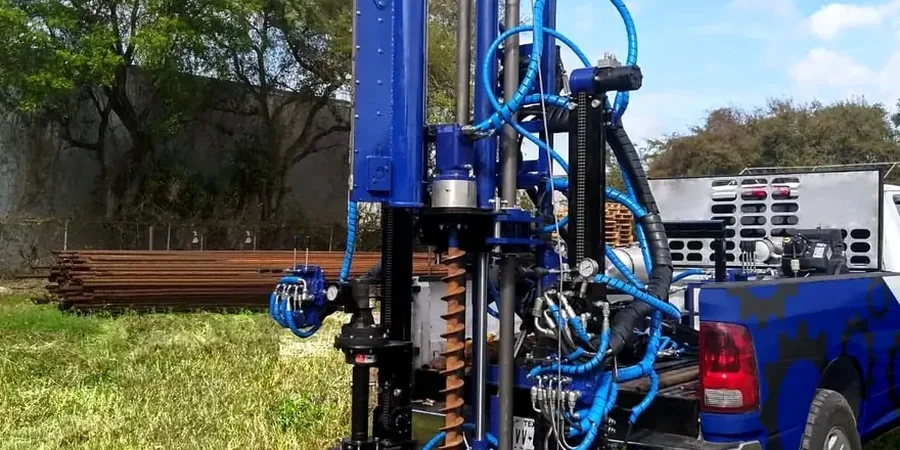
Site-specific factors
In Medicine Hat, we consistently observe that SPT refusal in the Bearpaw shale layer does not commit to uniform bearing across a site. The shale surface weathers unevenly under the glacial till, creating pockets of softened claystone that deflect the split spoon at shallow depths but still register high blow counts. Misreading these refusals as competent bedrock leads to differential settlement in slab-on-grade construction, particularly in the light industrial subdivisions south of the Trans-Canada Highway. Another local pattern involves the alluvial sands along Seven Persons Creek, where SPT N-values below 10 in the upper 5 meters signal loose, potentially collapsible fabric during wetting. Standard penetration testing in these zones must be paired with moisture-content profiles and Atterberg limit determinations on the fines fraction to avoid overestimating allowable bearing pressure under the CSA A23.3 framework.
Reference standards
ASTM D1586-18 – Standard Test Method for Standard Penetration Test (SPT) and Split-Barrel Sampling of Soils, CSA A23.3-19 – Design of Concrete Structures (foundation bearing references), NBCC 2020 – National Building Code of Canada (seismic site class determination)
Complementary services
SPT with Grain Size Analysis
Split-spoon samples go directly to the lab for sieve and hydrometer testing under ASTM D422. The grain size curve confirms whether the sand lenses encountered in the South Flats are uniformly graded (high liquefaction potential) or well-graded.
Combined SPT and Seismic CPT
Running a seismic cone next to the SPT borehole gives shear wave velocity (Vs) and N60 in the same profile. This dual approach satisfies NBCC requirements for Site Class C, D, or E determination without relying on N-value correlations alone.
SPT Monitoring for Deep Excavations
For basement excavations near the riverbank, we log SPT blow counts at multiple depths to track the transition from dry till to saturated sand. The data feeds lateral earth pressure models used in temporary shoring design.
Typical parameters
Common questions
What is the typical cost of an SPT investigation in Medicine Hat?
For a standard program involving two boreholes to 15 meters depth with full SPT sampling and a factual report, costs in Medicine Hat range from CA$760 to CA$1,080 per borehole. Total project cost depends on access conditions, traffic control on Highway 3, and laboratory testing scope.
How deep do SPT boreholes go for a residential foundation in Medicine Hat?
Most single-family residential investigations on the benches target 10 to 12 meters below grade. This depth captures the glacial till thickness and confirms refusal on the Bearpaw shale. In the river valley, where alluvial deposits are thicker, we extend to 15–18 meters to define the liquefiable sand layers.
Does the SPT provide enough data for a septic field design in the Medicine Hat area?
SPT data alone is insufficient for septic design. The test gives strength and relative density, but you need in-situ permeability testing or grain size analysis to estimate hydraulic conductivity. In the silty sands common around Desert Blume, we pair SPT with falling-head permeability tests in the same borehole.
How long does an SPT drilling program take on a typical Medicine Hat commercial site?
A two-borehole program to 15 meters with SPT sampling every 1.5 meters and field logging takes one full day of drilling. Laboratory classification testing adds 5 to 7 business days. The geotechnical report with N60 corrections, bearing capacity recommendations, and seismic site class follows within two weeks of site work completion.