Medicine Hat’s expansion from a railway tent town in 1883 to a city of over 63,000 meant building on the complex glaciofluvial deposits that line the South Saskatchewan River valley. The clay-rich till and scattered sand lenses across the city’s seven distinct coulees demand rigorous compaction verification—especially where residential subdivisions push into former ranchland north of the Trans-Canada Highway. Our team runs the sand cone field density test on trench backfill, structural fill, and pavement subgrades, measuring in-place density against the Proctor reference to confirm that lift work meets project specifications. In a region where freeze-thaw cycles can heave under-compacted clay within a single winter, field verification is not optional; it’s the difference between a stable slab and a cracked foundation four years in. We often combine the sand cone with grain size analysis when borrow source variability is suspected, and with CBR road testing on arterial road projects like the Dunmore Road corridor upgrades.
A density test isn’t just a number on a report—it’s the documented proof that every compacted lift will survive Medicine Hat’s 300-plus freeze-thaw cycles each year.
Our approach and scope
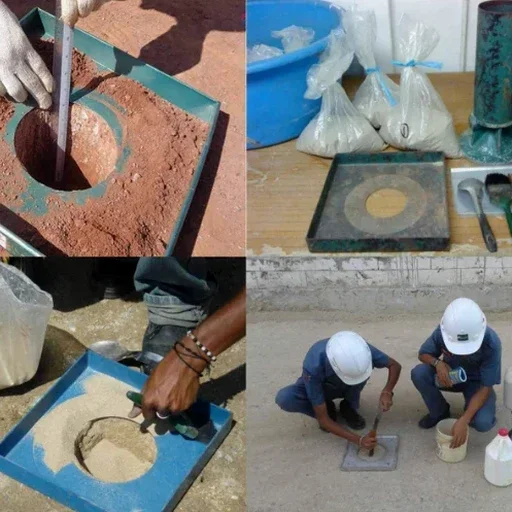
Site-specific factors
With Medicine Hat sitting at roughly 690 metres elevation on the high plains, the semi-arid climate produces a deceptive risk: surface soils dry hard in summer, leading some crews to skip moisture conditioning before compaction. Dry-of-optimum clay lifts may look solid after a pass of the sheepsfoot roller but typically fall 6–8% below specified density once tested—a gap that translates directly into differential settlement under slab-on-grade homes in neighbourhoods like Southlands. Worse, gas migration infrastructure around the city’s shallow Cretaceous formations requires pipeline trench backfill to hit 95% Proctor minimum; a single low-density zone can become a conduit for stray gas accumulation. The sand cone method gives us a destructive, self-checking measurement that doesn’t drift with soil chemistry the way nuclear gauges can, so we trust it as the referee method when disputes arise during third-party audits on City of Medicine Hat capital works.
Reference standards
ASTM D1556 – Standard Test Method for Density of Soil in Place by the Sand Cone Method, ASTM D698 – Standard Proctor; ASTM D1557 – Modified Proctor, NBCC 2020 – Part 4 structural design referencing geotechnical site parameters, CSA A23.3 – Concrete structures, requiring verified subgrade bearing for footings, City of Medicine Hat Engineering Standards – compaction acceptance for municipal infrastructure
Complementary services
Sand Cone Density Testing
Field density verification on compacted fill, trench backfill, and subgrade using calibrated Ottawa sand cones per ASTM D1556. Each test includes hole excavation, mass determination, moisture sample, and relative compaction calculation against lab Proctor data. We cover residential slabs in Ross Glen, pipeline spreads, and commercial pads in the Brier Park industrial area.
Proctor & Lab Compaction Curves
Standard and modified Proctor compaction curves developed in our soil mechanics lab from bulk samples collected on your site. The curve defines the maximum dry density and optimum moisture content that every sand cone result is measured against—without it, field density numbers are meaningless. We offer the complete curve, zero-air-voids line, and oversize correction when gravel fractions exceed 20%.
Typical parameters
Common questions
What does a sand cone field density test cost in Medicine Hat?
For most projects around Medicine Hat, a single sand cone test with the corresponding lab Proctor curve typically falls in the range of CA$120 to CA$180 per test point, depending on mobilization distance and the number of tests scheduled per day. Volume rates apply when we’re running 20-plus tests on a single site like a subdivision earthworks package.
How many sand cone tests do I need for my building pad?
Industry practice and City of Medicine Hat standards generally require a minimum of one test per 300 square metres per compacted lift. For a typical single-family home pad of 150 square metres, that means at least one test per lift; for a commercial building pad of 900 square metres, expect three tests per lift. Trench backfill follows a tighter grid—roughly one test every 30 linear metres.
Can you test gravelly fill with the sand cone method?
Yes, with limits. The sand cone method works reliably for soils with maximum particle sizes up to about 50 millimetres. When the fill contains cobbles or a high fraction of plus-19 mm gravel, we apply the oversize correction per ASTM D4718, adjusting the lab Proctor curve to account for the rock fraction. For very coarse, open-graded material, we may recommend switching to a water replacement method or correlating with a plate load test.
How soon do I get the density test results on site?
You’ll have a verbal pass/fail and the relative compaction percentage before we leave the test location—typically within 15 minutes once the moisture sample has been weighed and the calculation run against the Proctor curve. The formal signed report with test coordinates, lift number, and compaction curve overlay follows within 24 hours, or same-day for time-sensitive concrete placements.