The inclinometer casing goes down about thirty meters, right through the weathered shale until it hits competent bedrock. That’s the starting point for every slope stability analysis we run in Medicine Hat. The South Saskatchewan River has carved deep coulees through Bearpaw Formation clay shale, leaving slopes that look stable for decades and then move a meter in one spring melt. We pair continuous inclinometer readings with piezometer data and lab shear tests on undisturbed Shelby tube samples. For projects near the Seven Persons Creek confluence or along the Crescent Heights escarpment, we also integrate CPT soundings to map the smear zone where the clay shale grades into sand lenses, and we run seismic refraction lines to catch buried channels that don’t show up on conventional borehole logs.
In Medicine Hat’s Bearpaw shale, a slope that stood at 1.3:1 for fifty years can fail in one wet cycle if the bentonite seams are neglected in the analysis.
Our approach and scope
Site-specific factors
Medicine Hat sits at roughly 690 meters elevation, and the coulees drop 60 to 80 meters down to the river. That relief drives the entire slope stability problem. The 2013 southern Alberta floods didn’t hit Medicine Hat as hard as Calgary, but they were a wake-up call: saturated ground in the Bearpaw shale triggered multiple small slumps along the valley walls. The city’s Geotechnical Review Area maps, updated after the 2010 Coulee Ridge slide, now require slope stability reports for any development within the hazard setback zone. Skipping the analysis, or running a simplified infinite slope model that doesn’t capture the block kinematics, exposes the owner to liability and the engineer to disciplinary review under APEGA’s practice standards. We have seen Factor of Safety values drop from 1.6 to 0.9 just by adding a realistic perched water table at the till-shale contact.
Reference standards
NBCC 2020 (National Building Code of Canada, seismic provisions for Medicine Hat), CSA A23.3-19 (Design of Concrete Structures, retaining elements), ASTM D2435/D2435M-11 (One-Dimensional Consolidation Properties of Soils), ASTM D4767-11 (Consolidated Undrained Triaxial Compression Test for Cohesive Soils), City of Medicine Hat Geotechnical Review Area Guidelines
Complementary services
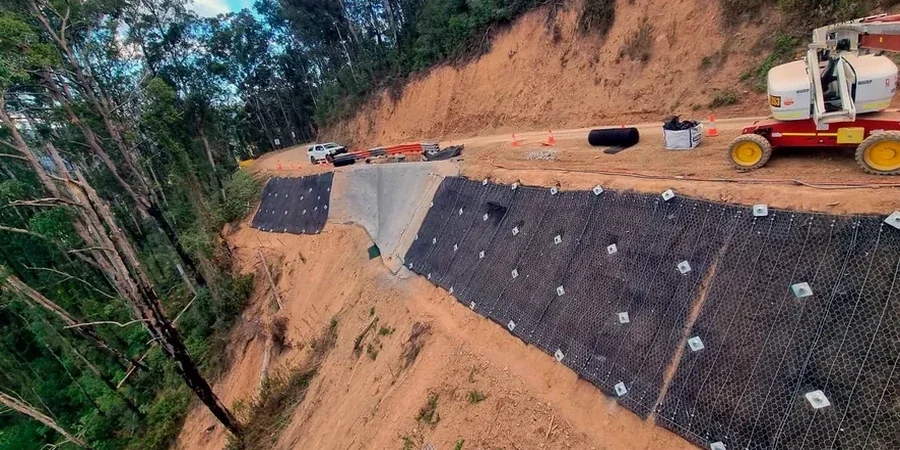
Limit Equilibrium & Finite Element Modeling
Multi-section stability models using peak and residual strength envelopes calibrated to our triaxial lab results. We run drained, undrained, and rapid drawdown scenarios, and we include seismic pseudo-static coefficients per NBCC 2020 for the Medicine Hat region. Outputs include slip surfaces, sensitivity analyses, and reinforcement recommendations.
Instrumentation & Monitoring Programs
Installation and data interpretation of inclinometer casings, standpipe and vibrating wire piezometers, and surface survey monuments. We set up automated alerts tied to displacement rate thresholds, which is critical during excavation near existing slopes in the coulee areas.
Typical parameters
Common questions
When does the City of Medicine Hat require a slope stability analysis for a building permit?
The city requires a slope stability report signed by a professional engineer for any development within the designated Geotechnical Review Area, which generally covers the coulee slopes along the South Saskatchewan River and Seven Persons Creek. The report must demonstrate a minimum Factor of Safety of 1.5 for static long-term conditions and address the influence of future development on adjacent slopes.
What laboratory tests do you run to get strength parameters for the Bearpaw shale?
We run consolidated-undrained (CU) triaxial tests with pore pressure measurement on intact Shelby tube samples, plus drained direct shear on the bentonite seams and slickensided surfaces. We also run Atterberg limits and particle size distribution to confirm the shale's classification. Peak and residual strength envelopes are generated for both the intact shale and the pre-sheared discontinuities, because the operational strength in an old landslide mass is often closer to residual.
What does a slope stability analysis cost for a residential lot in Medicine Hat?
For a typical single-lot analysis with one or two critical cross-sections, inclinometer data, lab testing, and a signed report, the cost ranges from CA$1,710 to CA$5,070 depending on how many boreholes are needed, whether we need to install piezometers, and the complexity of the stratigraphy.