Last season we reviewed a commercial development along the Seven Persons Creek coulee where the original cantilever wall design failed to account for the layered glacial till and clay shale bedrock. The contractor had assumed a uniform backfill, but the reality of Medicine Hat's geology—shaped by the South Saskatchewan River valley—is far more complex. We redesigned the structure with a mechanically stabilized earth system, integrating drainage that handles the freeze-thaw cycles typical of our 354 meters elevation and semi-arid climate. A retaining wall here must do more than hold back soil; it must accommodate lateral pressures from expansive clays and rapid spring snowmelt. Before finalizing any foundation scheme, we often recommend a test pit investigation to visually log the stratigraphy at the wall alignment, ensuring the design parameters match the actual ground conditions exposed during excavation.
A retaining wall in Medicine Hat fails not from the soil it holds today, but from the water it traps tomorrow.
Our approach and scope
Site-specific factors
Medicine Hat's development history stretches along the South Saskatchewan River valley, where early settlement built directly on the steep valley walls without engineered retention. Today, that legacy means many new projects sit adjacent to aging, unreinforced slopes. The biggest risk we encounter is underestimating the long-term creep of the Bearpaw Formation clay shale when wetted. A 2013 slope failure near the riverbank closed a section of the trail system for two seasons—a direct reminder that even modest cuts can mobilize deep-seated instability. We apply the at-rest earth pressure coefficients from the Canadian Foundation Engineering Manual and check global stability using Spencer's method for non-circular slip surfaces. In Medicine Hat, the wall's performance hinges on how well the design accommodates groundwater perched within the till, which often appears at depths of 2 to 4 meters during wet years. For deep excavations near existing structures, we pair our wall analysis with excavation monitoring to track lateral movements in real time.
Reference standards
NBCC 2015 (National Building Code of Canada), CSA A23.3-14 (Design of Concrete Structures), Canadian Foundation Engineering Manual, 4th Ed., ASTM D6913 (Particle-Size Distribution of Soils)
Complementary services
Gravity and Cantilever Wall Engineering
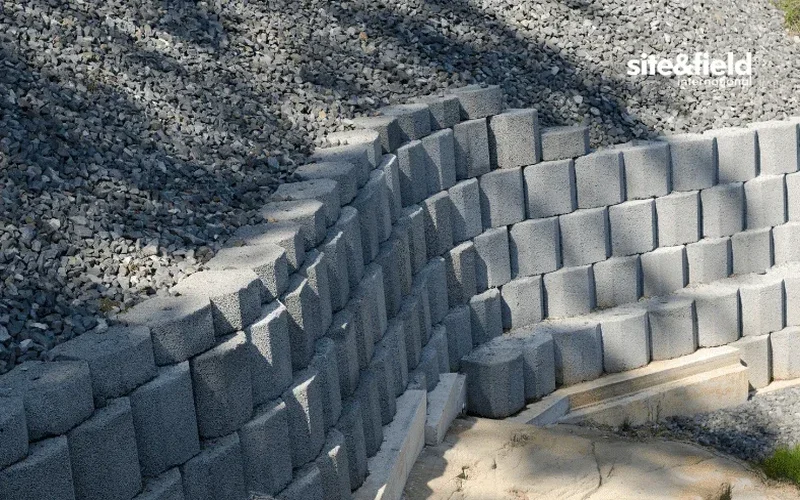
Complete structural and geotechnical design for cast-in-place concrete, segmental block, and gabion walls. We size the stem, heel, and toe based on the factored soil pressures from the site-specific investigation, and we detail the reinforcement per CSA A23.3.
MSE Wall and Slope Stabilization
Design of mechanically stabilized earth walls using geogrid or steel strip reinforcement. We analyze internal pullout and rupture capacity, external compound stability, and settlement compatibility with the underlying Bearpaw shale or till.
Typical parameters
Common questions
What is the typical cost range for a retaining wall design in Medicine Hat?
For a standard cantilever or MSE wall in Medicine Hat, the engineering design fee typically falls between CA$1,500 and CA$6,250. The range depends on wall height, site access constraints along the coulee slopes, and the number of soil borings required. An 8-foot wall with straightforward access sits at the lower end; a 20-foot wall near the river valley requiring multiple investigation points and global stability analysis will be at the upper end.
How does the local clay shale affect retaining wall design?
The Bearpaw Formation clay shale, which underlies much of Medicine Hat, is particularly sensitive to moisture changes. When exposed in a cut, it weathers rapidly from a rock-like material to a soft clay. We specify a protection layer of shotcrete or a geotextile wrap on the cut face, and we design the wall drainage to intercept any water moving along the shale-till interface. The residual friction angle we use for the weathered shale is typically 14 to 18 degrees, which is significantly lower than the intact value.
What is the design life for a permanent retaining wall in Medicine Hat?
We design permanent retaining walls for a minimum 75-year service life per the Canadian Highway Bridge Design Code CAN/CSA-S6, which we adopt as the benchmark for all permanent infrastructure. This requires durable concrete with a minimum 50 MPa compressive strength, air entrainment for freeze-thaw resistance, and epoxy-coated rebar where de-icing salts may be present. The drainage system must remain functional without maintenance for the same period, so we avoid materials prone to clogging.