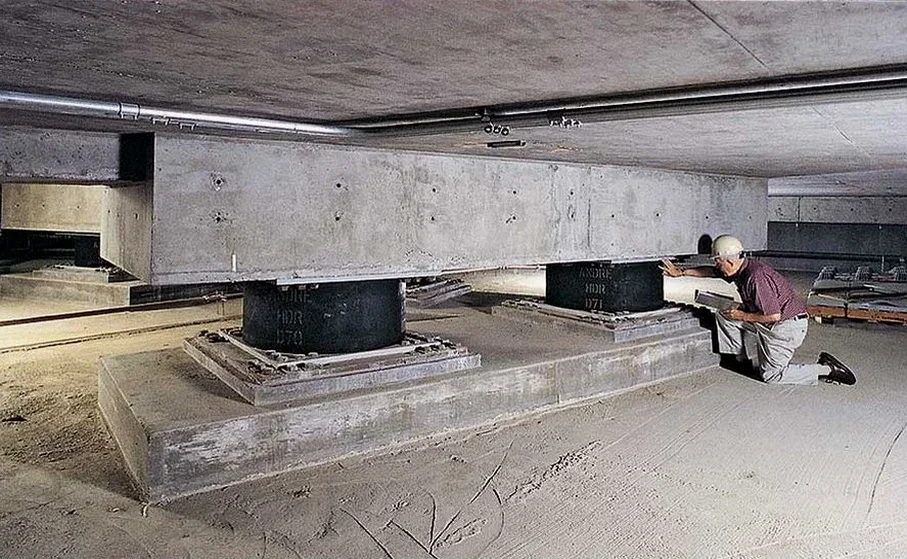
A three-story medical clinic near the South Saskatchewan River valley sat on 18 meters of soft alluvial clay. The structural engineer called us after conventional fixed-base design showed excessive interstory drift under the NBCC 2020 spectrum for Medicine Hat. We ran site-specific response analysis using shear wave velocity profiles from downhole testing, then modeled lead-rubber bearings with effective periods shifted to 2.8 seconds. The isolation plane reduced spectral acceleration demands by 62 percent. That project reinforced what we see across the valley corridor: base isolation isn't overengineering here. It's the most direct path to meeting drift limits without oversized shear walls. For sites with similar stratigraphy we often pair the seismic microzonation data with isolator prototyping before finalizing the structural design.
Shifting the fundamental period from 0.4 seconds to 2.8 seconds cuts base shear by over 60 percent, which changes the entire cost equation for mid-rise construction in the valley.
Our approach and scope
Site-specific factors
NBCC 2020 places Medicine Hat in a moderate seismic zone, but the soft soil amplification across the river valley pushes spectral ordinates well above what firm-ground maps suggest. A fixed-base hospital designed to the base shear from Division B Part 4 can still knowledge floor accelerations that damage non-structural components during a 475-year event. We see this risk manifest in sites where the shear wave velocity drops below 180 m/s in the upper 20 meters. Base isolation decouples the superstructure from those amplified ground motions. The critical failure mode we engineer against is bearing instability under maximum displacement: the isolator must sustain vertical load at 1.2 times the dead load plus seismic overturning while displaced to the MCE level. Missing this check—or ignoring the moat wall clearance—leads to pounding against retaining walls or basement slabs. For deep excavations near the riverbank, the isolation system must also tolerate differential settlement without locking up.
Reference standards
NBCC 2020 (National Building Code of Canada) Part 4, Division B, CSA A23.3:2019 Design of Concrete Structures, Annex D (anchorage), ASTM D4015 Standard Test Methods for Modulus and Damping of Soils by the Resonant-Column Method, CSA S16:19 Design of Steel Structures, ASCE/SEI 7-22 Chapter 17 (Seismic Isolation), referenced as supplementary guidance
Complementary services
Isolation System Design and NLTH Analysis
We model the superstructure as a simplified stick model or import the full ETABS/SAP2000 model, then run nonlinear time-history analysis with site-matched ground motions. The output package includes isolator force-displacement hysteresis, story drift profiles, floor acceleration spectra, and moat wall impact checks. All results are benchmarked against NBCC 2020 upper- and lower-bound isolator properties.
Geotechnical Site Characterization for Isolation Design
We execute the subsurface investigation and laboratory testing required to classify the site per NBCC Table 4.1.8.4.A and develop site-specific response spectra. This includes downhole shear wave velocity profiling, resonant column testing, and cyclic direct simple shear on undisturbed samples from the Bearpaw Formation and overlying alluvium.
Typical parameters
Common questions
How does the NBCC 2020 treat base isolation compared to fixed-base design?
NBCC 2020 Clause 4.1.8.12 provides the specific procedure for seismically isolated structures. The code allows a response modification factor Rd = 2.0 and overstrength factor Ro = 1.3 for the isolation system, with the superstructure designed for reduced forces based on the isolated period. Time-history analysis is mandatory; equivalent static procedure is only permitted for preliminary sizing.
What soil conditions in Medicine Hat make base isolation particularly suitable?
The deep alluvial deposits along the South Saskatchewan River valley and weathered Bearpaw Formation shale create Site Class D and E conditions. These soft soils amplify long-period ground motion, which increases demands on conventional fixed-base structures. Base isolation shifts the building period above the amplified range, reducing acceleration transfer to the superstructure.
What is the typical cost for base isolation design on a mid-rise building in Medicine Hat?
For a typical mid-rise project, the base isolation design package including geotechnical characterization, NLTH analysis, and isolator specification ranges from CA$5.560 to CA$11.770 depending on the building footprint and number of ground motion pairs required. A detailed quote follows review of the architectural floor plans and preliminary geotechnical data.
Do you test the isolators before installation?
Yes. We require prototype testing per the manufacturer's quality control program, typically two full-scale bearings tested to three cycles at design displacement and one cycle at MCE displacement. We review the test reports against the design hysteresis loops and confirm the effective stiffness and damping fall within the upper- and lower-bound limits used in analysis.
How do you handle the moat wall and utility crossings with an isolated building?
The moat wall must offer the full MCE displacement plus a 50 mm gap on all sides. Utility crossings use flexible couplings rated for the total displacement, with loops or expansion joints detailed to avoid rupture. We coordinate these details with the mechanical and electrical consultants and include the gap verification in the construction review phase.