The National Building Code of Canada (NBCC) and CSA A23.3 set the framework for concrete pavement structures, but in Medicine Hat the real design challenge lies underground. The city's location in the South Saskatchewan River valley exposes pavement subgrades to highly plastic Cretaceous clays and silty deposits that shift dramatically with seasonal moisture. A pavement that meets only the minimum structural thickness without accounting for local subgrade variability will crack within the first few freeze-thaw cycles. Our rigid pavement design approach starts with a detailed geotechnical investigation to determine the modulus of subgrade reaction (k-value), which directly controls slab thickness and joint spacing. We combine laboratory testing of local soils with Westergaard and finite element analysis methods to produce designs that handle both the heavy truck traffic on the Trans-Canada Highway corridor and the thermal curling stresses typical of southern Alberta winters.
A rigid pavement in Medicine Hat is only as good as the subgrade it rests on; the k-value and joint load transfer efficiency determine whether a slab lasts 10 years or 40.
Our approach and scope
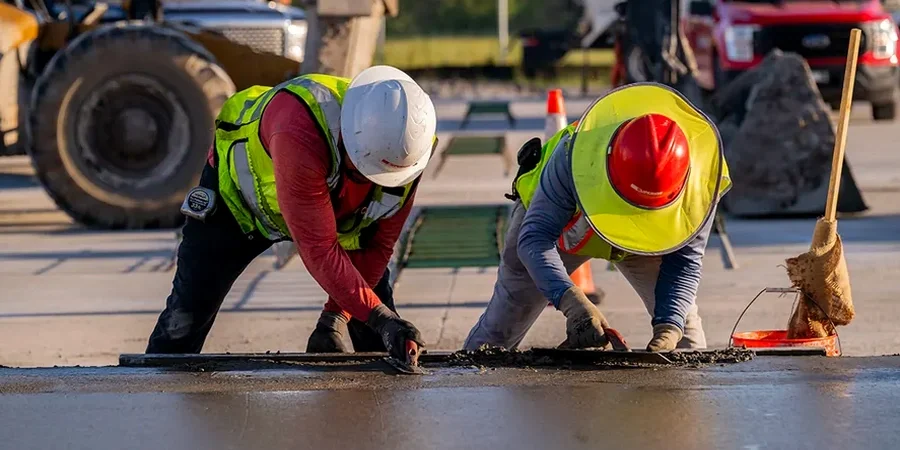
Site-specific factors
A mistake we see repeatedly in the Medicine Hat area is paving contractors installing concrete slabs directly onto untreated Bearpaw clay subgrade to save on excavation costs. The clay swells during spring snowmelt and the Red Deer River's seasonal rise, then shrinks during the dry summer months when Medicine Hat receives less than 350 mm of annual precipitation. This volume change creates voids under the slab corners, and within two winters the panels begin rocking under traffic loads. Once corner breaks appear, pumping of the fines through the joints accelerates, and the entire pavement section deteriorates rapidly. A proper rigid pavement design mandates a non-frost-susceptible granular subbase at least 450 mm thick, separated from the clay by a geotextile filter fabric. Skipping this step turns a 30-year design life into a maintenance liability within five years, especially on industrial access roads where loaded tandem axles apply corner stresses that exceed the concrete's fatigue limit.
Reference standards
CSA A23.3: Design of Concrete Structures, NBCC 2020 (National Building Code of Canada), CSA A23.1/A23.2: Concrete Materials and Methods of Test Construction, ASTM D1196: Standard Test Method for Nonrepetitive Static Plate Load Tests of Soils (k-value), TAC Pavement Design and Asset Management Guide (Transportation Association of Canada)
Complementary services
Subgrade Reaction Modulus (k-value) Testing
Field plate load tests per ASTM D1196 on prepared subgrade and subbase layers to determine the k-value required for Westergaard-based thickness design.
Joint Load Transfer Efficiency (LTE) Assessment
Falling weight deflectometer testing across transverse joints to measure LTE and identify panels requiring full-depth repair or dowel bar retrofit.
Freeze-Thaw Durability Mix Design Review
Evaluation of concrete mix proportions against CSA A23.1 exposure class C-1, including air-void system parameters and supplementary cementitious material content for sulfate resistance.
Geotechnical Investigation for Pavement Rehabilitation
Boreholes and test pits through existing concrete to sample subgrade soils, measure in-situ moisture, and identify the root cause of distress before designing the rehabilitation overlay or reconstruction.
Typical parameters
Common questions
What is the typical rigid pavement design life for a collector road in Medicine Hat?
With proper geotechnical preparation and concrete mix design, we target a 30 to 35-year structural design life for collector roads in Medicine Hat. This assumes a traffic loading spectrum based on AADT projections for the South Saskatchewan River valley corridor, a stabilized subbase, and adequate joint sealing maintenance. The actual service life depends heavily on winter de-icing salt exposure and the frequency of heavy truck traffic from the energy sector.
How much does a rigid pavement design cost for a commercial parking lot in Medicine Hat?
For a typical commercial parking lot in Medicine Hat, the geotechnical investigation and rigid pavement design package ranges from CA$2,300 to CA$9,750. The scope includes subgrade sampling, laboratory classification, plate load testing for k-value determination, and the final thickness and jointing plan. Larger industrial yards with poor subgrade conditions fall at the upper end because of the additional stabilization design required.
Does Medicine Hat's semi-arid climate reduce the risk of pavement pumping?
It reduces the frequency, but not the severity. Medicine Hat averages under 335 mm of annual precipitation, so saturation events are less frequent than in coastal climates. However, when spring snowmelt combines with the clay subgrade's low permeability, water becomes trapped at the slab-subgrade interface. The pumping mechanism still occurs under repeated heavy axle loads, and the dry summers that follow cause the clay to shrink and create voids. A free-draining granular subbase remains essential regardless of the arid climate classification.
What joint spacing do you recommend for unreinforced concrete pavements in southern Alberta?
For unreinforced rigid pavements in the Medicine Hat region, we typically specify transverse joint spacing between 4.0 and 4.5 metres, which is tighter than the standard 4.5 to 5.0 metres used in milder climates. The shorter spacing accounts for the extreme temperature range that produces high curling stresses. The joint depth must be at least one-quarter of the slab thickness, and we specify a saw-cut window within 6 to 12 hours after finishing to prevent random thermal cracking.
Can you design a rigid pavement overlay on an existing asphalt road?
Yes, bonded and unbonded concrete overlays on existing asphalt are a common rehabilitation strategy we design for Medicine Hat. The key is determining whether the asphalt base is structurally sound or has stripping and fatigue cracking. We core through the existing pavement to measure layer thicknesses and perform dynamic cone penetrometer tests to assess the remaining support. For unbonded overlays, a separation interlayer prevents reflective cracking from the old asphalt joints. More info.